
Editor’s Note
This article was originally published in June 2024 and substantially updated in September 2026 to reflect how application-specific context, signal correlation, and guided remediation define depth in modern SaaS security.
SaaS security depth comes from understanding how configurations, identities, permissions, data access, third-party connections, and activity combine to create risk inside critical applications. Here is how to distinguish meaningful depth from surface-level coverage.
Key takeaways
- Breadth establishes visibility across the SaaS estate, but visibility alone isn’t enough. Application count alone doesn’t equal comprehensive security. Depth protects the applications that hold an organization’s most sensitive data with app-specific context and analysis.
- Correlating disparate security signals reveals how seemingly minor issues combine into larger risks and helps teams prioritize the changes that reduce the most exposure.
- Clear context and remediation guidance help security teams work with application owners to resolve risk, then extend protection across the broader SaaS estate.
Organizations need visibility across a growing number of SaaS applications, but they also need strong protection for the platforms that hold their most sensitive data, privileged identities (human and NHIs), and business-critical workflows.
A broad approach can help teams discover and monitor more of the SaaS estate. A depth-focused approach concentrates security expertise and resources on the applications where a compromise would create the greatest business impact. It examines how configurations, identities, permissions, data access, third-party connections, and activity interact inside each app.
The strongest SaaS security programs use both. They start with in-depth protection for critical applications, then expand coverage through repeatable processes as the program matures.
What breadth and depth mean in SaaS security
Breadth refers to the scope of SaaS applications a security program can discover, monitor, or assess. It helps teams build visibility across a growing SaaS estate and identify where security ownership or controls may be missing.
Depth refers to how thoroughly a security platform understands and protects an individual SaaS application. It goes beyond basic attributes available through common APIs and accounts for the app’s unique configurations, access models, roles, permissions, identities, data, connected apps, and attack vectors.
Broad visibility helps teams map the SaaS attack surface. Deep analysis helps them understand how risk develops inside the applications that matter most and gives them enough context to act.
Prioritize your most critical SaaS applications first
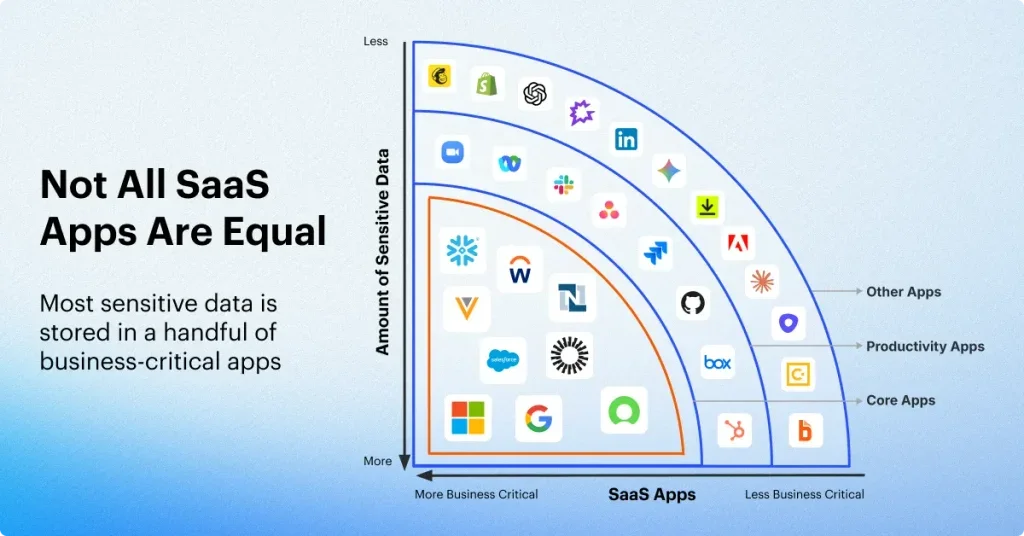
At first glance, applying the same level of coverage to every SaaS application can appear to be the safest approach. But not all SaaS applications present equal business risk. Platforms such as Salesforce, Microsoft 365, ServiceNow, and Workday often contain the bulk of sensitive data, privileged identities, and workflows that many organizations depend on every day.
These applications also have complex and highly specific configuration controls, which require more than confirming that a few baseline settings are enabled. They’re also where threat actors increasingly focus their attention. Recent attacks involving Microsoft 365, Salesforce, ServiceNow, show a recurring pattern making headlines: Abuse identities, OAuth tokens, or trusted third-party connections to bypass traditional controls and eventually reach ransomable data. Security teams need continuous visibility into how users, permissions, configurations, data, integrations, and activity change over time.
A depth-first strategy prioritizes these critical SaaS platforms first. By starting with a “walk, run, fly” approach to SaaS security, teams ensure their most business-critical data is secured first. Then, they can broaden the program as resources and processes mature.
What security depth actually looks like inside a SaaS app
Here’s an example: consider a basic multi-factor authentication (MFA) check in Salesforce. Knowing whether MFA is enabled provides one useful signal. A deeper assessment shows which users can still authenticate through weaker methods, what access those users have, which roles and permission sets contribute to that access, which connected applications or tokens extend it, and what data or business processes may be exposed.
This application-specific context helps a security team understand the full risk rather than treating each setting as an isolated pass-or-fail result. The same principle applies across other platforms, but the underlying details differ. Microsoft 365 roles and conditional access policies, ServiceNow ACLs and integrations, and Workday security groups each require distinct knowledge and analysis.
Depth depends on sustained application research, threat research, and an understanding of how each platform implements access and control. A generic, surface-level integration can collect data, but deep coverage interprets that data in the context of how the application actually works.
Depth reveals how security signals connect
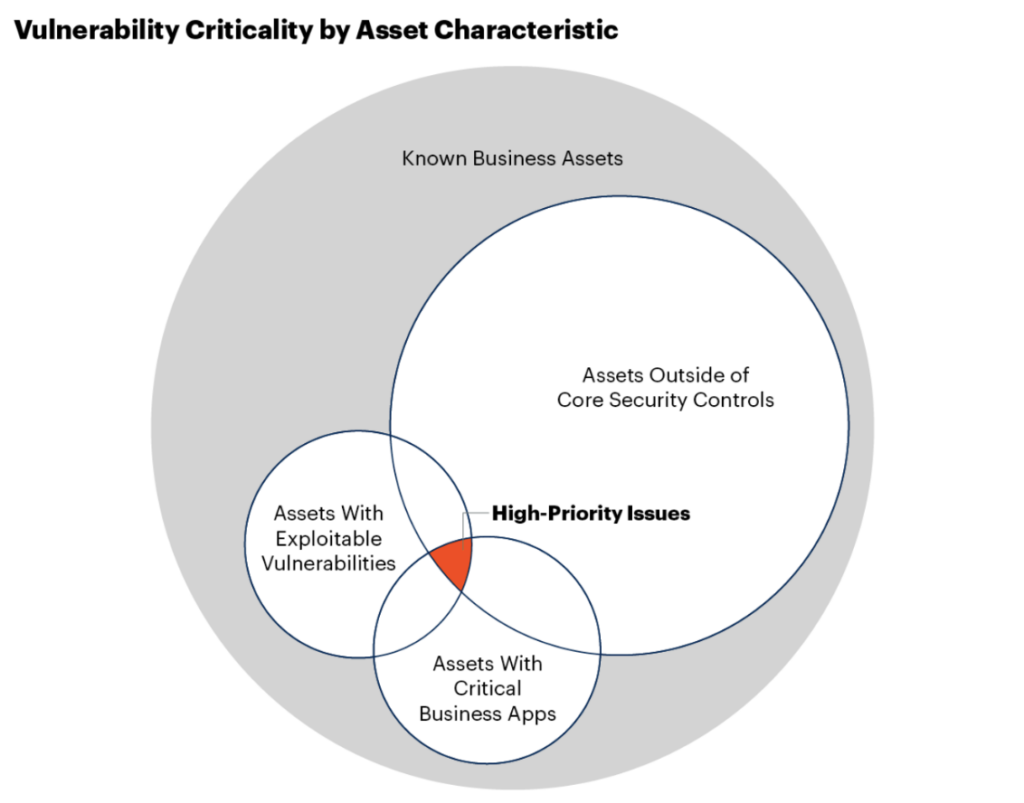
SaaS risks rarely exist in isolation. A configuration issue in a major SaaS platform that appears minor on its own may become more serious when it affects a privileged identity, exposes sensitive data, connects to an over-permissioned third-party application, or coincides with suspicious activity.
Deep SaaS security brings posture, identity, permissions, data access, third-party connections, and threat signals together to understand the bigger picture. Correlating these elements reveals interdependencies and helps teams see when several small conditions create a larger attack path or exposure.
This context also improves prioritization. Rather than working through a queue of disconnected findings, teams can focus on the risks with the greatest potential impact. They may also find that one remediation addresses several related issues, reducing more risk with less manual effort.
Depth turns security findings into action
Identifying a risk is only one part of the job. Security teams need to understand:
- Why the issue matters
- Who or what is affected
- How to resolve it safely
Clear evidence and application-specific remediation guidance create a common language between security teams and SaaS app owners. Bridging that common disconnect is critical. Instead of handing another team a generic alert, security can show the relevant configuration, identity, permission, integration, or data path and explain how those elements create exposure.
That level of detail builds credibility. It helps application owners validate the issue, understand its business impact, and make the appropriate change without relying on the security team to become the administrator for every SaaS platform.
Build depth across the full SaaS security picture
When evaluating a SaaS security platform, consider how well it brings together the capabilities needed to understand and reduce risk inside your most critical applications. The number of checks can provide one point of comparison, but the complete picture matters more.
A depth-focused approach should include:
- Posture management that evaluates application-specific configurations and policies
- Identity and access analysis that reveals effective permissions, privilege, and access paths
- Visibility into third-party applications, integrations, OAuth connections, and other non-human identities
- Data access monitoring that identifies sensitive or broadly exposed information
- Threat detection informed by application-specific attack techniques and activity
- Prioritized insights that connect related signals and explain their combined impact
- Clear remediation guidance that security teams and application owners can use
Together, these capabilities help teams move from individual, isolated observations to a contextual understanding of risk and action.
Use autonomous correlation to make SaaS security depth operational
Even when a platform collects deep application telemetry, security teams cannot manually investigate every possible relationship across complex SaaS environments. It’s just not humanly possible. Each application includes thousands of settings and interactions, and few teams can maintain expert-level knowledge across every platform they support.
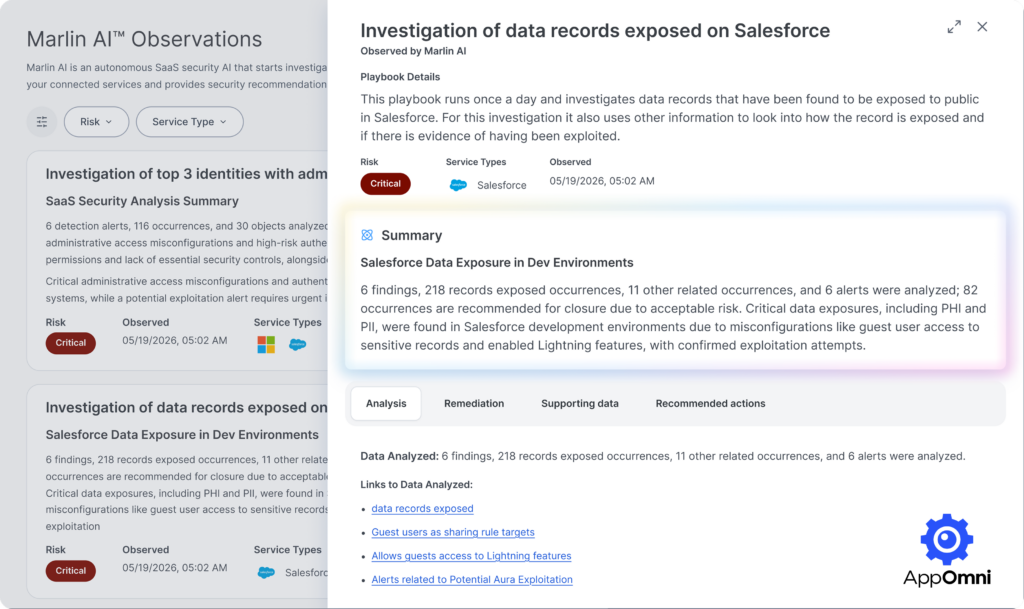
Marlin AI, for example, builds on AppOmni’s SaaS and AI observability platform to autonomously correlate security indicators, investigate risks, surface incidents, and provide guided remediation. It connects the posture, identity, access, data, third-party, and threat context surrounding an issue so teams can understand what needs attention and why.
By distilling related signals into prioritized insights, Marlin helps teams spend less time assembling context and more time resolving the risks that matter.
The bottom line
Maintaining broad visibility into which SaaS applications are in use, who owns them, and where security coverage may be missing is an important part of managing the SaaS attack surface. But visibility alone doesn’t provide the application-specific context needed to protect the platforms that hold an organization’s most sensitive data and support its most critical business processes.
- Start by applying deeper protection to those critical applications. Understand how configurations, identities, permissions, data access, third-party connections, and activity interact to create risk. Continuously monitor those signals as the environment changes, correlate them to prioritize what matters, and give security teams and application owners clear guidance to resolve issues.
- Then expand the program across the broader SaaS estate through repeatable processes and scalable monitoring.
Effective SaaS security isn’t a choice between breadth and depth. It’s knowing where depth matters most, while maintaining the visibility needed to manage the rest of the SaaS environment.
See how AppOmni turns complex SaaS signals into prioritized risks and guided remediation. Request a demo today.
Frequently asked questions
What is breadth in SaaS security?
Breadth is the scope of SaaS applications a security program can discover, monitor, or assess. It helps organizations understand the size of their SaaS estate and identify gaps in visibility or ownership.
What is depth in SaaS security?
Depth is the level of application-specific context and analysis a security platform provides. It includes understanding configurations, identities, permissions, data access, third-party connections, activity, and how those security signals combine to surface risk factors.
Should organizations prioritize breadth or depth first in SaaS security?
Organizations should establish broad visibility while applying the deepest protection to their most business-critical SaaS applications first. They can then expand coverage as their processes, resources, and program maturity grow.
How does signal correlation improve SaaS security?
Signal correlation connects related information across configurations, identities, permissions, data access, third-party applications, and activity in a SaaS security management platform (SSPM). This helps teams identify larger risks (with a potentially large blast radius), prioritize what to fix first (remediation), and avoid treating every finding as an isolated issue.
SaaS Security Buyer’s Guide
Accelerate your organization’s SaaS security journey with a detailed criteria for choosing the right SSSPM) platform.
Additional Resources
-
Zoom Breach at Federal Reserve Shows the Need for SaaS Security
A SaaS security misconfiguration led to a high-profile Zoom bombing, preventing the Federal Governor from delivering his remarks at a virtual event.
-

Zero Trust’s Weak Spot: SaaS Apps Aren’t Playing By The Same Rules
Organizations that rely solely on ZTNA or similar network-focused defenses often mistakenly believe their SaaS applications are protected.
-
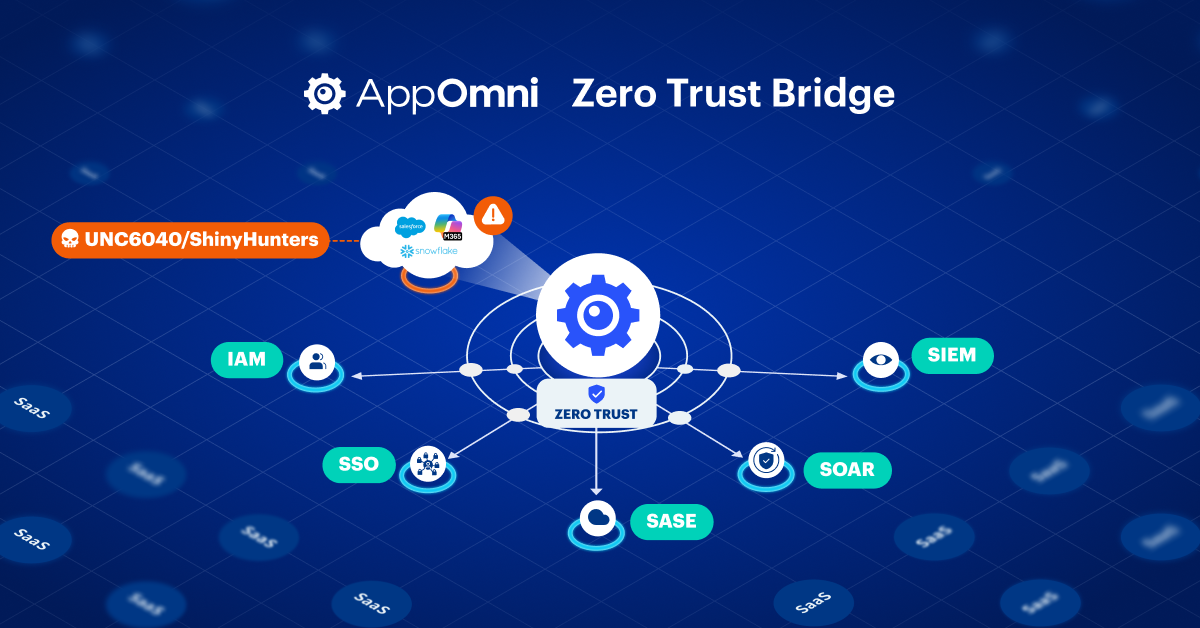
Zero Trust Needs a Bridge: How to Unlock Shared Signals for SaaS Now
Zero Trust Bridge activates shared signals in SaaS, boosting real-time risk detection with AppOmni.