
DevSecOps Definition
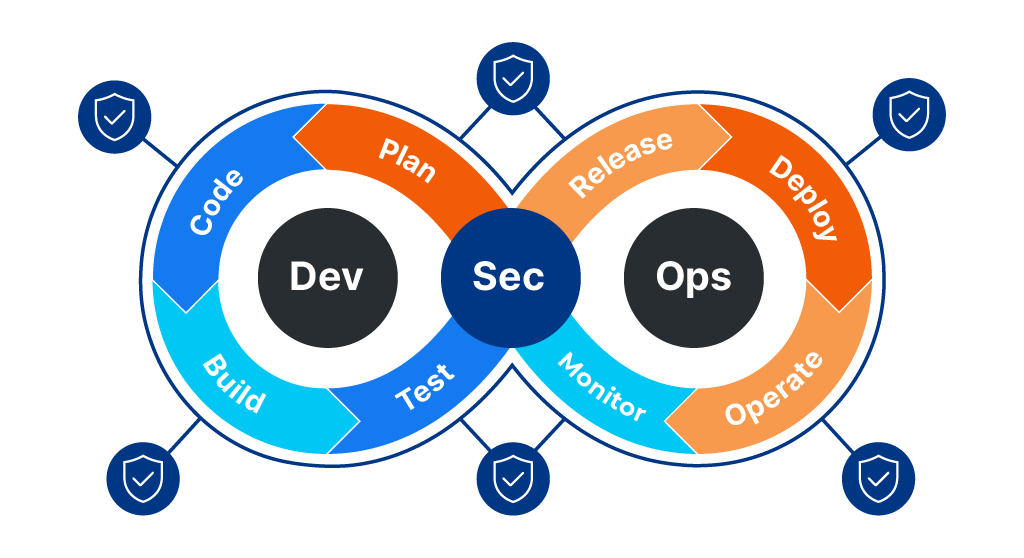
DevSecOps stands for Development, Security, and Operations. It’s a modern approach that builds security into every stage of the software development lifecycle instead of treating it as a final step. The goal is to make security a shared responsibility between developers, IT, and security teams, so code is tested, secured, and deployed faster and more safely.
DevSecOps FAQs
What is DevSecOps Exactly and How is it Different From DevOps?
In practice, DevSecOps combines automation, continuous integration and delivery (CI/CD), and secure coding practices to identify and fix software vulnerabilities early, helping organizations release software that’s both reliable and resilient from day one. This represents a shift in how software is built and delivered. Unlike traditional DevOps, which focuses on speed and automation for development and operations, DevSecOps integrates security into every stage of the software lifecycle.
A good DevSecOps framework provides the processes, tools, and workflows needed to embed security checks, compliance validation, and vulnerability scanning directly into the CI/CD pipeline. It ensures that security is not a last-minute step but a continuous, automated practice.
The DevSecOps principles emphasize shared responsibility, continuous monitoring, and proactive risk management. Developers, operations, and security teams work together to identify and fix vulnerabilities early, enforce secure coding practices, and maintain compliance.
Why is DevSecOps Important?
DevSecOps is important because modern software environments are increasingly complex, dynamic, and cloud-based, which increases the attack surface. Applications often rely on multiple integrations, third-party APIs, and SaaS services, making traditional, end-of-cycle security insufficient.
By embedding security into development pipelines, DevSecOps engineers help organizations reduce the likelihood of costly breaches, ensure faster incident detection, and improve resilience against evolving threats. It also supports regulatory compliance and audit readiness by continuously enforcing security policies.
DevSecOps Automation: Why It’s Important and How to Do It
DevSecOps automation is essential because modern development cycles demand speed that manual security processes cannot match. Automated security workflows enable organizations to continuously scan code, configurations, and dependencies, identify vulnerabilities at early stages, and maintain compliance standards without impeding development velocity or postponing releases.
A well-designed DevSecOps architecture incorporates automated security controls throughout the pipeline, ensuring consistent protection across all stages of development and deployment. Following DevSecOps best practices means embedding secur
ity from the start and maintaining continuous validation through automation. This approach is particularly critical for SaaS security, where cloud applications and APIs evolve rapidly and require constant vigilance. Automated monitoring detects misconfigurations, overly permissive access controls, and vulnerable integrations before attackers can leverage them. By removing manual processes, automation eliminates inconsistencies, delivers uniform security coverage across all environments, and enables security teams to concentrate their expertise on sophisticated, high-priority threats.
How to Implement DevSecOps Automation:
- 1. Integrate security into CI/CD pipelines – Use automated code scanning, static and dynamic application security testing (SAST/DAST), and dependency checks as part of every build and deployment.
- 2. Automate policy enforcement – Apply infrastructure-as-code (IaC) and configuration-as-code tools to continuously validate settings and compliance requirements.
- 3. Use automated monitoring and alerting – Continuously track runtime behavior and SaaS configurations for anomalies or unauthorized changes.
- 4. Shift-left security practices – Move testing and vulnerability detection earlier in development, so developers fix issues before code is deployed.
- 5. Leverage orchestration and remediation tools – Connect automated findings to ticketing or workflow systems to ensure vulnerabilities are tracked and addressed efficiently.
What Are the Main Challenges Companies Face When Adopting DevSecOps?
Adopting DevSecOps can be transformative, but it comes with several common challenges. One major hurdle is cultural change. Developers, operations, and security teams often work in silos, and shifting to a model where security is everyone’s responsibility requires training, buy-in, and ongoing collaboration.
Another challenge is tool integration and automation. Organizations often use multiple CI/CD platforms, code repositories, cloud services, and SaaS applications. Ensuring that security tools integrate smoothly into these pipelines without slowing down development can be complex.
Visibility and monitoring across dynamic cloud and SaaS environments is also difficult. Misconfigured permissions, API exposures, and rapid changes in cloud infrastructure can create blind spots if security isn’t continuously automated and monitored.
Finally, skills gaps are a common issue. Many organizations struggle to find engineers who understand both development processes and security best practices, which makes implementing a full DevSecOps approach challenging.
Strengthen DevSecOps with Comprehensive SaaS Security
DevSecOps ensures security is integrated throughout the software development lifecycle, helping teams build, test, and deploy applications safely and efficiently. As organizations increasingly rely on SaaS applications, traditional DevSecOps practices may miss risks like misconfigurations, third-party integrations, and rapidly changing cloud environments.
AppOmni extends DevSecOps principles into SaaS security, by providing AI security posture management, continuous monitoring, real-time threat detection, and automated policy enforcement across platforms like Microsoft 365, Salesforce, and Google Workspace. Integrating AppOmni into your DevSecOps workflow strengthens security, closes visibility gaps, and helps teams maintain compliance while supporting agile, secure development.