
When we talk about AI, we’re not just talking about passive content generation anymore. We’re talking about agentic AI, which operates as a new type of identity within SaaS environments, making decisions autonomously and executing tasks independently across ecosystems. At the same time, AppOmni research indicates that 75% of organizations experienced a SaaS-related security incident in the past year, and permission and identity issues were responsible for 41% of those incidents. Modern AI agents amplify this risk because they can fetch data, create users, and modify system configurations. Because these actions often occur without traditional human-in-the-loop oversight, they significantly expand the enterprise attack surface. This blog examines the top AI risks in SaaS environments and the strategies practitioners can use to mitigate them.
1. Agentic workflow compromise and cascading failures
The first major risk involves agentic workflow compromise and its cascading failures. This occurs when a single compromised agent or poisoned component propagates malicious actions across a multi-agent pipeline. Attackers exploit broken authentication in AI provider APIs to gain a foothold.
The BodySnatcher vulnerability, tracked as CVE-2025-12420, illustrates this threat clearly. This vulnerability used universal, hardcoded secrets such as “servicenowexternalagent” and insecure auto-linking logic. Unauthenticated attackers could have impersonated any user, including administrators, by knowing only a target email address.
The impact of this type of compromise is significant: It allows attackers to bypass Single Sign-On (SSO) and Multi-Factor Authentication (MFA). Once the perimeter is breached, attackers can remotely take charge of privileged workflows to create backdoor admin accounts or exfiltrate sensitive data.
How to combat unauthenticated agentic hijacking:
- Organizations must enforce MFA for all account-linking processes
- Security teams should move from basic email-based linking to software-based authenticators
- Credential rotation must ensure that provider-level secrets are unique per instance
- And organizations should de-provision internal execution paths, such as AIA-Agent Invoker AutoChat to prevent agents from running outside of expected constraints.
2. Second-order prompt injection in agent-to-agent workflows
Second-order prompt injection represents a sophisticated threat to interconnected SaaS systems. Attackers insert malicious instructions into data fields or workflows rather than directly into the initial prompt. When a benign AI agent processes this poisoned data, it’s tricked into recruiting a more powerful agent to execute a malicious task. This method leverages the inherent trust between interconnected SaaS agents to achieve unauthorized goals. These attacks can result in cross-system escalation and data siphoning, all without the need for stolen credentials.
How can teams mitigate second-order prompt injection attacks?
- Security teams should mandate human-in-the-loop confirmation for any agent operating in a supervised execution mode
- Segmentation is also essential to isolate agents by role and privilege level. This prevents low-privilege agents from accessing administrative tools
- Finally, organizations must apply least privilege access controls to the specific tools an AI agent can use, such as restricting record management functionalities.
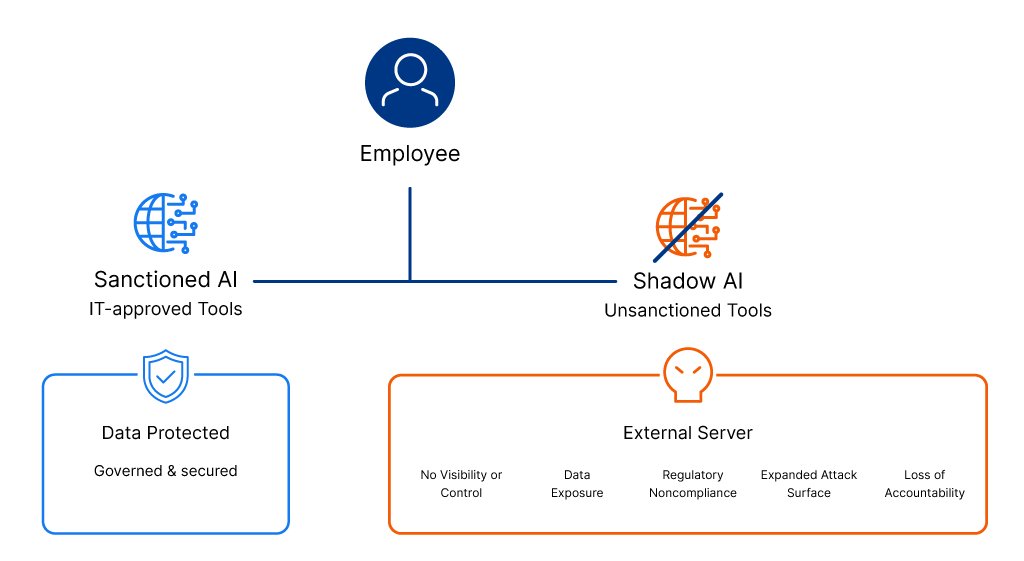
3. Shadow AI: Unsanctioned agents in approved SaaS apps
Shadow AI occurs when employees use unapproved AI features embedded in sanctioned SaaS platforms like Salesforce or Microsoft 365. Many of these embedded tools have broad data access by default but have not passed formal security reviews. This lack of oversight creates a significant risk of unintended data exposure.
Shadow AI can create blind spots in data residency and potential violations of compliance regulations like GDPR. There is also a persistent risk that sensitive corporate data could be used to train third-party models.
How organizations can fight shadow AI risks:
- Organizations must prioritize AI inventory and discovery to identify all embedded copilots and agents connected through OAuth.
- An automated review process should be implemented to manage the agent approval lifecycle.
- Additionally, security teams should identify and disable dormant agents that have been unused for 90 days or more to reduce the attack surface.
4. Compliance conflicts from automated data gathering
AI agents often create compliance conflicts through automated data gathering. These agents may inadvertently violate privacy regulations such as GDPR by fetching sensitive personal data to provide better context for their responses. Because the majority of confidential enterprise data resides in SaaS applications, the scope of this risk is broad.
Organizations often attempt to address this problem with a second AI model to clean the gathered data, but this creates a vicious cycle. The second model gains access to the same sensitive information, increasing the risk of a data exposure.
How to address the risks from AI data gathering:
- Organizations should implement planner scope restrictions. This limits data-fetching scope at the planner topic level so agents access only necessary tables
- And security teams should apply domain-specific data vetting instead of relying on generic AI models for compliance scrubbing.
5. SaaS identity hijacking
SaaS identity hijacking uses AI to bridge the gap between social engineering and technical system access. This creates an opportunity for threat actors to use AI to mimic legitimate human behavior at scale and bypass the modern SaaS perimeter. We saw this in attacks like EvilToken, which targeted SaaS-native authentication, such as device code flows, to trick users into granting access. This risk is amplified further by AI-generated deepfake audio and video used to impersonate executives and authorize fraudulent SaaS integrations.
Because identity is the primary perimeter for SaaS environments, identity hijacking attacks allow criminals to gain legitimate access to sensitive data and interconnected cloud applications. Once inside, attackers exploit overprivileged accounts to move laterally without triggering traditional network security alerts.
Steps for stopping AI-driven identity hijacking:
- Security practitioners must implement post-authentication SaaS monitoring to audit behavior for anomalies like unusual token usage
- OAuth and consent governance are also required to restrict user consent for new integrations
- And organizations should use security tools that identify non-human patterns and detect AI-generated deepfakes.

6. Model inversion, data extraction, and membership inference
In model inversion and data extraction attacks, criminals probe AI models to reveal sensitive training data or private records. They can reconstruct confidential information by querying model APIs or analyzing Retrieval-Augmented Generation (RAG) vector data. These model inversion attacks can expose intellectual property and private corporate records stored within SaaS databases, increasing the risk of a data exposure.
Further, criminals can determine if a specific private record was part of a model’s training dataset through membership inference attacks, which can expose sensitive enterprise records that were used in model training or processing. Attackers also use LLM decomposition to break down model responses and extract proprietary information. They analyze and split model outputs into smaller components to isolate hidden patterns or sensitive details, which can enable systematic extraction of proprietary data embedded in model responses.
How to defend against model inversion attacks:
- Practitioners should use differential privacy techniques to add noise to training data so a model’s output does not rely on any single, specific data point. This helps prevent attackers from reconstructing private information through model queries
- Enforcing strict API rate limiting is also necessary to prevent the high volume of queries required for data reconstruction attacks
- Finally, organizations should mask sensitive information before indexing it into vector data for RAG systems.
7. Multimodal adversarial attacks
Threat actors can use crafted inputs or poisoned data to deceive AI models that process multiple types of media. Multimodal adversarial attacks target text, charts, and image-text combinations to produce risky or fraudulent outputs.
For example, an attacker can add subtle artifacts to a financial chart image alongside a misleading caption, causing the model to recommend a high-risk trade while the advisory appears routine. Or in the medical industry, adversarial noise in scans can lead to dangerous misdiagnoses. These are subtle, intentionally crafted distortions in medical imaging data that can mislead AI systems into interpreting scans incorrectly, producing inaccurate clinical outputs that affect diagnosis and treatment decisions.
Because simple defenses are often bypassed, multimodal adversarial attacks require robust and multi-layered detection.
Protecting against multimodal adversarial attacks:
- Practitioners should conduct multimodal red teaming to stress-test applications against adversarial inputs
- Adversarial training can also help models recognize and ignore malicious artifacts in images
- And robust input validation must be implemented to ensure the integrity of all data types before they’re processed by the AI.
The era of agentic governance
AI security is shifting from prompt filtering to identity governance. Organizations must now treat AI agents as operators and apply the same Zero Trust principles used for human administrators. Because AI agents are becoming more powerful, their security controls must match the risk they pose to the enterprise.
FAQ: Systemic AI security risks in SaaS
What are the top AI risks in SaaS environments?
The top risks include agentic workflow compromise, second-order prompt injection, shadow AI, compliance conflicts from automated data gathering, SaaS identity hijacking, model inversion, and multimodal adversarial attacks.
What makes agentic AI more dangerous than standard generative AI?
Generative AI (GenAI) creates content while agentic AI takes action. Agentic AI can create users, change passwords, and delete records, which makes it a high-privilege identity.
Why can’t my CASB detect shadow AI inside my SaaS apps?
Traditional CASBs can see that an approved SaaS app is in use, but they lack the deep context required to see if an unapproved AI feature inside that app is siphoning data.
How can security teams address AI security risks in SaaS applications?
Security teams need complete visibility into AI usage and data access, including for AI functionality embedded within SaaS apps. Organizations can mitigate AI risks in SaaS by focusing on discovering existing AI, enforcing least privilege, implementing continuous anomaly detection, securing AI configurations and blocking malicious AI prompts.
Securing the autonomous enterprise against AI security risks
Securing the autonomous enterprise requires moving beyond point-in-time AI security. Periodic patches are necessary, but they don’t solve the systemic risk of insecure AI configurations. The only way to keep pace with the 2026 threat landscape is through continuous, identity-centric monitoring of the AI-to-SaaS relationship. AppOmni is dedicated to providing these capabilities so that AI remains a productivity asset rather than a security liability. Learn more about how AppOmni can help you secure your AI-driven SaaS environment.