
Most enterprises have already invested heavily in cloud and access security. CSPM is in place. SASE or SSE is deployed. CASB is monitoring cloud usage. Identity is centralized. On paper, the environment looks well-protected. But the attack surface has shifted, and many SaaS security coverage strategies haven’t fully kept up.
Today, critical business data lives inside SaaS applications like Salesforce, ServiceNow, Microsoft 365, and more. Yet they introduce a different kind of risk that traditional cloud and access security tools weren’t designed to address.
To understand the gap, it helps to break down what each layer actually secures.
| Function | CSPM | SASE | CASB | SSPM |
| Cloud infrastructure misconfiguration detection | ✅ | ❌ | ❌ | ❌ |
| SaaS configuration assessment | ❌ | ❌ | ❌ | ✅ |
| Identity and access visibility within cloud resources | ✅ | ❌ | ❌ | ❌ |
| Identity and access visibility within SaaS apps | ❌ | ❌ | ⚠️ Limited | ✅ |
| Data Loss Prevention (DLP) | ❌ | ✅ | ✅ | ⚠️ Partial |
| User access control (device, location, context) | ❌ | ✅ | ✅ | ❌ |
| Network traffic inspection | ❌ | ✅ | ⚠️ Partial | ❌ |
| Shadow IT discovery | ❌ | ⚠️ Partial | ✅ | ✅ |
| OAuth app and third-party integration visibility | ❌ | ❌ | ⚠️ Limited | ✅ |
| SaaS-to-SaaS integration mapping | ❌ | ❌ | ❌ | ✅ |
| Detection of data exposure inside SaaS apps | ❌ | ❌ | ❌ | ✅ |
| Compliance monitoring (cloud infrastructure) | ✅ | ❌ | ❌ | ❌ |
| Compliance monitoring (SaaS applications) | ❌ | ❌ | ⚠️ Limited | ✅ |
| Continuous posture management | ✅ | ❌ | ❌ | ✅ |
| Threat prevention | ❌ | ✅ | ✅ | ❌ |
| API-based visibility into SaaS environments | ❌ | ❌ | ⚠️ Partial | ✅ |
What CSPM secures: Cloud infrastructure
Cloud Security Posture Management (CSPM) focuses on the environments you build and manage (IaaS and PaaS).
It answers foundational questions like:
- Are cloud resources configured securely?
- Are IAM roles overly permissive?
- Are network paths unintentionally exposed?
CSPM provides strong coverage across:
- Misconfigurations in AWS, Azure, and GCP
- Workload posture across virtual machines, containers, and serverless
- Infrastructure compliance aligned to frameworks like CIS, NIST, and SOC 2
- Network exposure and connectivity risks
This layer is essential. It reduces risk at the foundation and ensures that what you deploy in the cloud is configured securely.
However, CSPM is limited to infrastructure. It does not extend into SaaS applications, where security risks are driven by configurations, identities, and data access inside platforms you don’t control.
What SASE secures: Access, network traffic, and the edge
Secure Access Service Edge (SASE) combines networking and security into a unified, cloud-delivered model designed for distributed users and applications.
SASE typically includes capabilities like:
- Zero Trust Network Access (ZTNA) for secure remote access
- Secure Web Gateway (SWG) for web traffic inspection
- Firewall-as-a-Service (FWaaS)
- CASB for SaaS access control
Its core purpose is to secure how users and devices connect to applications and data.
SASE enables organizations to:
- Enforce consistent access policies across users, devices, and locations
- Inspect and secure traffic as it moves across networks
- Apply Zero Trust principles to modern, distributed environments
- Protect against threats in transit (e.g., malware, risky sessions)
Because all traffic is routed through SASE infrastructure, it provides strong visibility and control over data in motion and access paths.
However, SASE does not extend into the internal workings of SaaS applications. It does not track:
- SaaS configuration settings
- Internal permission models
- SaaS-to-SaaS integrations
- Data exposure within the application
In other words, SASE secures the path to the app, not what happens inside it.
What CASB secures: SaaS access and data in motion
Cloud Access Security Brokers (CASB) sit between users and cloud applications, acting as a control point for enforcing security policies.
CASBs are designed to answer questions like:
- Who is accessing which SaaS applications?
- Is sensitive data being shared or downloaded inappropriately?
- Are users behaving in risky or anomalous ways?
They provide key capabilities such as:
- Data Loss Prevention (DLP) to stop sensitive data exfiltration
- Access control based on user identity, device, and location
- Threat detection (e.g., unusual logins, malware activity)
- Visibility into sanctioned and unsanctioned SaaS usage
CASBs are highly effective at controlling user interactions and data movement across cloud services.
But their visibility is fundamentally limited:
- They monitor traffic and activity, not application internals
- They rely on proxy or API-based enforcement, meaning some access paths can be bypassed
- They cannot fully assess SaaS configurations, permissions, or integration risks
For example, CASBs can detect if a file is shared externally, but not whether a Salesforce sharing rule is misconfigured or an OAuth app has excessive permissions.
As a result, CASB acts as an access controller, not a configuration or posture management solution.
Where SSPM fits: Securing what happens inside SaaS
When you look across CSPM, SASE, and CASB, a clear pattern emerges:
- CSPM secures what you build (cloud infrastructure)
- SASE secures how users connect (network and access paths)
- CASB secures how SaaS is used (activity and data in motion)
But none of these layers fully answer a critical question: What’s happening inside the SaaS application itself?
That’s where SaaS Security Posture Management (SSPM) comes in.
SSPM operates at the application layer where most modern business activity happens. It provides continuous visibility into how SaaS applications are configured, how access is granted, and how data is exposed.
SSPM enables organizations to:
- Monitor configuration drift across SaaS applications
- Understand identity posture within apps, including MFA coverage and privilege sprawl
- Identify and assess OAuth-connected applications and third-party risk
- Map SaaS-to-SaaS integrations and their impact on data exposure
- Detect publicly exposed data and misconfigured environments
This level of insight allows security teams to move from periodic audits to continuous SaaS risk management—improving both visibility and response time.
This is fundamentally different from the other layers:
- CSPM doesn’t extend into SaaS environments
- SASE operates in the traffic path, not inside the application
- CASB monitors activity, but lacks deep configuration context
These gaps are not theoretical—they are where real-world incidents occur. Research shows that 75% of organizations experienced a SaaS-related security incident in the past year, often tied to misconfigurations and identity risks rather than infrastructure vulnerabilities.
SSPM closes this gap by continuously assessing the state of the application itself, not just how it’s accessed or used.
Without SSPM, organizations can control access and monitor activity, but still miss the underlying misconfigurations and identity risks that often lead to real-world incidents.
As SaaS environments grow in scale and complexity, these visibility gaps become harder to manage without dedicated visibility into the application layer.
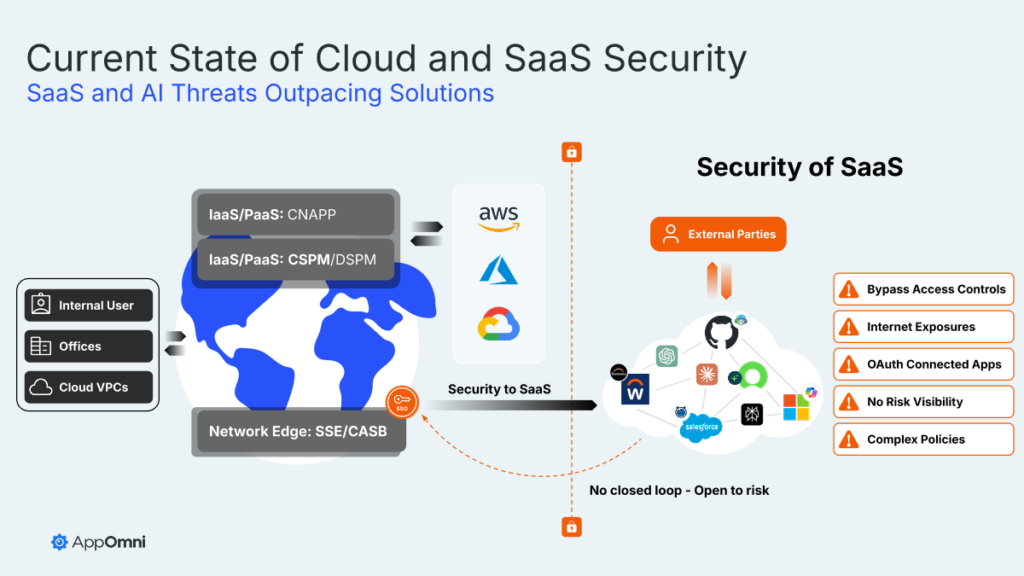
Where the layers of SaaS security coverage connect
While each layer (CSPM, SASE, CASB, and SSPM) has a defined role, risk doesn’t stay neatly within boundaries.
Modern environments are interconnected through identities, access paths, and APIs. Gaps often emerge between layers, not just within them.
Here’s where this shows up:
- Identity across cloud and SaaS (CIEM + IdP): Human and machine identities span both infrastructure and SaaS applications. Overprivileged access, weak authentication policies, or identity sprawl can introduce risk that requires visibility across multiple layers, not just one.
- Access paths and traffic (SASE and CASB): SASE and CASB provide strong control over how users access SaaS and how data moves. But they operate in the traffic path, meaning they don’t have full visibility into how applications are configured or how permissions behave once access is granted.
- APIs and SaaS-to-SaaS integrations: SaaS applications are deeply interconnected. Integrations between SaaS apps (and between cloud workloads and SaaS) create new access paths that expand the attack surface. These are often invisible without application-layer visibility.
- Data in motion vs. data at rest: CASB and SASE are effective at monitoring data in motion. SSPM complements this by identifying risks in data at rest within SaaS, including misconfigurations and excessive access that expose sensitive information.
Together, these layers form the connective tissue of modern security. But without visibility into each layer (especially inside SaaS) risk can accumulate in ways that are difficult to detect.
Closing the SaaS security coverage visibility gap
Security leaders don’t need more tools for the sake of coverage, they need complete visibility across how their environments actually operate.
- CSPM secures what you build
- SASE secures how users connect
- CASB secures how SaaS is used
- SSPM secures the applications that run the business
Most organizations already have the first three, leaving visibility gaps.
But as SaaS becomes the system of record for critical data and workflows, the application layer becomes the most important (and often least visible) part of the environment.
Extending security into SaaS isn’t about replacing existing investments. It’s about completing them.
You can’t secure what you can’t see. And today, most of what matters lives inside SaaS.