
Identity and Access Management Definition
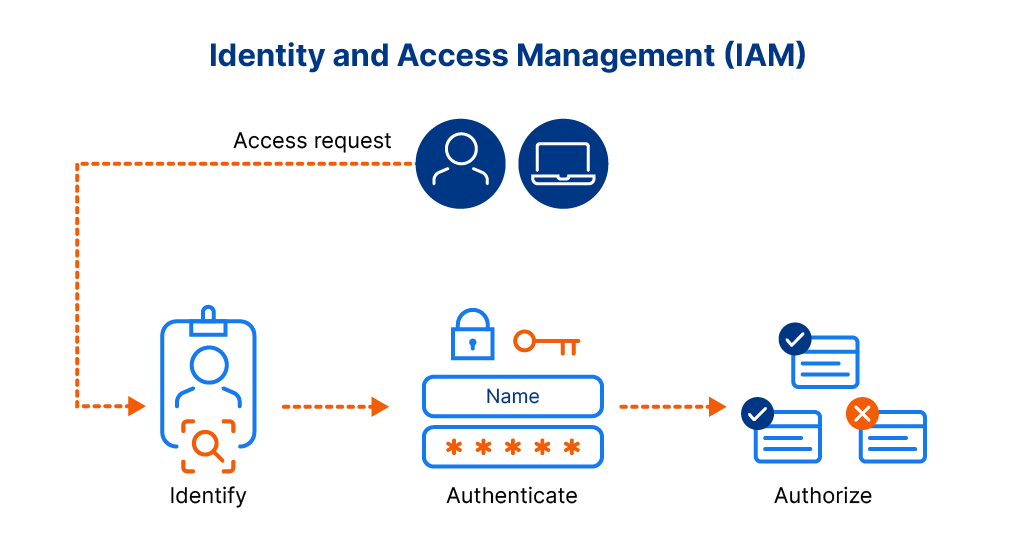
Identity and Access Management (IAM) is a cybersecurity framework of policies and technologies that ensures the right users can securely access an organization’s resources. IAM systems primarily focus on authentication (authn), verifying digital identities across applications, systems, networks, and cloud platforms, while providing coarse-grained authorization (authz), such as determining which applications or services a user can access. IAM platforms may also provision and deprovision user accounts—either passively through mechanisms like just-in-time (JIT) provisioning when a valid login is detected for an unknown user, or actively through standards such as SCIM. Fine-grained authorization decisions are typically enforced within the applications themselves, as IAM providers generally do not have visibility into application-specific business logic.
Identity and Access Management FAQs
What is Identity and Access Management?
Identity and Access Management (IAM) is a core cybersecurity discipline that governs who or what can access organizational resources, under what conditions. IAM systems manage digital identities for both human users – such as employees, contractors, partners, and customers as well as non-human entities including applications, devices, APIs, and automated workloads. As organizations move from perimeter-based, on-premises networks to distributed hybrid, multi-cloud, and SaaS environments, identity and access management systems are becoming a critical security control and are widely considered the new security perimeter.
Beyond login management, IAM addresses the full identity lifecycle: provisioning identities, authenticating access requests, authorizing permissions based on policy and context, and deprovisioning access when it’s no longer needed. Modern identity and access management products span on-premises systems, cloud infrastructure, SaaS applications, and mobile environments, providing consistent governance regardless of where users or resources reside.
Why Is Identity and Access Management Important?
Identity and access management in cybersecurity has become indispensable because digital identities represent both the primary target for attackers and the fundamental control point for protecting organizational assets. The shift to cloud computing, remote work, and distributed IT environments has eliminated the traditional security perimeter where firewalls once provided adequate protection. Organizations now face the challenge of securing access for users who connect from anywhere, using various devices, to access resources spanning on-premises data centers, multiple cloud platforms, and third-party SaaS applications. Without effective IAM, security teams cannot answer critical questions about who has access to which systems, what those users are doing with their permissions, or whether credentials have been compromised.
The threat landscape demonstrates why identity and access management tools are essential rather than optional. Credential theft and abuse of valid accounts consistently rank among the leading causes of data breaches, with attackers recognizing that stolen credentials provide a path of least resistance into corporate networks. Once threat actors obtain legitimate credentials, they can operate undetected as authorized users, moving laterally through networks, escalating privileges, and exfiltrating confidential information. Organizations lacking strong IAM controls struggle to detect these attacks because malicious activity appears identical to normal user behavior.
Identity and access management risks extend beyond external threats to include insider dangers and compliance failures. Employees with excessive permissions pose risks through both malicious actions and unintentional errors, while former employees whose access wasn’t properly terminated can retain system access long after departure. Compliance frameworks including GDPR, HIPAA, SOX, and PCI-DSS mandate strict controls over who can access sensitive data and require detailed audit trails of privileged activities. Organizations without IAM systems cannot demonstrate compliance during audits, exposing themselves to significant fines, legal liability, and reputational damage.
How Does Identity and Access Management Work?
Identity and access management solutions operate across four core pillars:
- Administration
- Authentication
- Authorization
- Auditing
Identity administration establishes and manages digital identities for every user and entity that requires access. Each identity includes attributes such as credentials, roles, and permissions, stored in a centralized or federated directory (such as Active Directory or a cloud identity provider) that serves as the authoritative source for access decisions.
Authentication verifies that users are who they claim to be before access is granted. Modern IAM systems go beyond passwords by enforcing multi-factor authentication (MFA) and adaptive authentication, which evaluate contextual signals such as location, device posture, and behavioral patterns to dynamically adjust authentication requirements based on risk.
Once authenticated, authorization determines what resources users can access and which actions they can perform. While role-based access control (RBAC) remains the most common approach, modern IAM platforms increasingly support attribute-based and policy-based access models that evaluate user attributes, resource sensitivity, and real-time context. These models enable more granular, least-privilege access decisions, particularly in cloud and SaaS environments.
Auditing completes the framework by continuously logging authentication events, access decisions, and user activity. These audit trails help security teams detect suspicious behavior, investigate incidents, demonstrate regulatory compliance, and continuously refine access policies.
Benefits of Identity and Access Management
Organizations that implement comprehensive IAM programs experience significant security improvements and operational advantages that extend across their entire IT infrastructure. Identity and access management solutions deliver measurable value by addressing the complete lifecycle of digital identities and access privileges, with benefits that accumulate over time as IAM programs mature and create a foundation for secure digital transformation initiatives.
Key Benefits for Enterprises and SaaS Providers:
- Reduced cyber risk and smaller attack surface – Eliminating unnecessary access privileges and enforcing least-privilege principles dramatically limit the pathways attackers can exploit to compromise critical systems and sensitive data.
- Prevention of credential theft and lateral movement – Multi-factor authentication, adaptive authentication, and session monitoring stop attackers from using stolen credentials to move between systems and escalate privileges throughout the network.
- Enhanced visibility and threat detection – Continuous monitoring of user activities combined with behavioral analytics and identity threat detection capabilities enables security teams to identify suspicious activities and respond to incidents before they cause damage.
- Simplified regulatory compliance – Comprehensive audit trails and automated access controls help organizations meet requirements for GDPR, SOC, PCI-DSS, HIPAA, and other frameworks while reducing the time and resources needed for compliance reporting and audits.
- Lower operational costs and improved efficiency – Automating identity provisioning, password management, and access requests eliminates manual processes that consume IT resources and introduce human error, freeing administrators to focus on strategic initiatives.
- Seamless user experience with single sign-on – SSO capabilities allow users to access multiple applications with one set of credentials, reducing password fatigue and support tickets while maintaining strong security through centralized authentication.
- Protection against insider threats – Granular access controls and continuous activity monitoring detect both malicious insiders abusing their privileges and accidental misconfigurations by well-meaning users before they result in data breaches.
- Secure cloud and hybrid environments – IAM extends consistent security policies across on-premises infrastructure, public cloud platforms, and SaaS applications, ensuring access remains protected regardless of where resources reside.
- Faster incident response and forensics – Detailed activity logs and session recordings provide security teams with the evidence needed to investigate breaches quickly, understand exactly what occurred during security incidents, and implement targeted remediation.
Best Practices for Identity and Access Management
Implementing IAM requires more than deploying technology, it demands a strategic approach that combines robust policies, disciplined processes, and continuous improvement. Organizations that follow established best practices for identity and access management create resilient security programs that adapt to evolving threats while supporting business agility and user productivity.
Adopt Zero Trust Architecture
Modern IAM programs should embrace zero trust principles that assume no user or device is inherently trustworthy, regardless of network location. This means verifying every access request explicitly, granting only the minimum privileges required, and assuming that breaches will occur. Zero trust IAM implementations authenticate and authorize users continuously rather than relying on a single perimeter check, preventing attackers who compromise one credential from moving freely across the network.
Implement Strong Multi-Factor Authentication
Passwords alone cannot adequately protect modern organizations. Require MFA for all users and consider adaptive authentication that adjusts requirements based on risk signals. Prioritize phishing-resistant authentication methods such as FIDO2 passkeys or hardware security tokens for high-value accounts. Organizations should extend MFA beyond human users to protect machine identities, service accounts, and API credentials that attackers increasingly target.
Enforce Least Privilege and Just-in-Time Access
Users should receive only the minimum permissions necessary to perform their specific job functions, with elevated privileges granted temporarily when needed and automatically revoked after use. Regularly review and recertify user permissions to prevent privilege creep, where employees accumulate unnecessary access over time. For privileged accounts, implement just-in-time access models that provision elevated permissions on demand rather than maintaining standing administrative access that creates persistent security risks.
Automate Identity Lifecycle Management
Manual provisioning and deprovisioning processes introduce delays and errors that create security gaps. Automate the creation of user accounts when employees join, modification of permissions when roles change, and immediate deactivation when users leave the organization. Integration between IAM systems and HR platforms ensures identity changes reflect organizational reality, while automated workflows reduce the burden on IT teams and eliminate orphaned accounts that attackers can exploit.
Centralize Identity Governance and Visibility
Consolidate identity management across on-premises, cloud, and SaaS environments into unified platforms that provide comprehensive visibility into who has access to what resources. Fragmented IAM implementations create blind spots where unauthorized access goes undetected and compliance gaps emerge. Centralized governance enables consistent policy enforcement, streamlined auditing, and the ability to quickly identify and remediate access anomalies or policy violations across the entire digital ecosystem.
Monitor Continuously and Respond to Anomalies
Deploy identity threat detection and response (ITDR) capabilities that use behavioral analytics and machine learning to identify suspicious authentication patterns, unusual privilege usage, and potential credential compromise. Establish baseline patterns for normal user behavior and trigger alerts when deviations occur, such as impossible travel scenarios, access from unfamiliar devices, or attempts to access resources outside typical work hours. Automated response capabilities should immediately challenge or block high-risk access attempts while security teams investigate.
Maintain Comprehensive Audit Trails
Log all authentication attempts, authorization decisions, privilege changes, and user activities to create detailed audit trails that support forensic investigations and compliance requirements. Retain logs according to regulatory mandates and ensure they cannot be tampered with or deleted by users. Regular analysis of audit data helps organizations identify security weaknesses, optimize access policies, and demonstrate to auditors that appropriate controls are functioning as designed.Provide Security Awareness Training
Even the strongest technical controls can be undermined by users who fall victim to phishing attacks or share credentials. Educate users about common attack vectors, the importance of protecting authentication factors, and how to recognize and report suspicious access requests. Training should emphasize that security is a shared responsibility and that users play a critical role in protecting organizational assets by following IAM policies and reporting anomalies.
Difference Between Identity and Privileged Access Management
Identity and Access Management (IAM) and Privileged Access Management (PAM) are complementary components of an organization’s identity security strategy, but they address different risk profiles. IAM provides broad identity governance across all users and entities (employees, contractors, customers, applications, and devices) managing the full identity lifecycle from provisioning and authentication to authorization and deprovisioning. It supports everyday access scenarios using capabilities like single sign-on, role-based access control, and standard authentication policies.
Privileged Access Management is a specialized subset of IAM focused on securing high-risk accounts with elevated permissions, such as administrators, root accounts, service accounts, and emergency credentials. Because these accounts can access critical systems and sensitive data, PAM applies stronger controls, including credential vaulting and rotation, just-in-time privileged access, session isolation and recording, and enhanced monitoring to detect misuse.
The key difference is scope and security intensity. IAM manages access for the entire identity population, while PAM applies rigorous, targeted protections to the small set of accounts that pose the greatest risk if compromised. Together, IAM and PAM form a layered defense that balances usability for standard users with strict controls for privileged access, reducing the risk of lateral movement, privilege escalation, and insider threats.
Identity and Access Management Solutions
Identity and access management solutions support modern enterprises through a range of deployment models, including cloud-based identity-as-a-service (IDaaS), on-premises implementations, and hybrid architectures. Core IAM platforms typically combine directory services, authentication and authorization engines, identity governance and administration (IGA), customer identity and access management (CIAM), and privileged access management (PAM).
Beyond traditional IAM platforms, the market includes specialized solutions designed for emerging risks and environments. Identity threat detection and response (ITDR) tools use behavioral analytics to identify compromised credentials and anomalous access activity. Cloud-native IAM solutions focus on securing identities across multi-cloud and SaaS environments using modern protocols like OAuth and OpenID Connect. Organizations may also deploy point solutions such as password and secrets management tools, federation and single sign-on services, and identity analytics platforms. Selecting the right IAM approach depends on factors like identity scale, cloud adoption, compliance requirements, integration needs, and whether a consolidated platform or best-of-breed tools better align with organizational maturity and architecture.
Identity and Access Management for SaaS Applications
AppOmni bridges the critical gap between enterprise IAM platforms and the complex permission models that govern access inside SaaS applications. While traditional IAM solutions control authentication and verify who can log in, they lack visibility into native SaaS roles, permissions, and access configurations. Security teams may know a user successfully authenticated to Salesforce, Microsoft 365, or ServiceNow, but not whether that user holds administrative privileges, can access sensitive data, or violates least-privilege policies.
As a purpose-built SaaS Security Platform for SaaS and AI Security, AppOmni extends identity and access management into the applications where critical data and business processes live. The platform continuously monitors permissions, administrative roles, service accounts, and API tokens across leading SaaS environments, correlating enterprise IAM identity data with actual in-app privilege usage. With AI-powered threat detection, automated posture management, and comprehensive auditing, AppOmni ensures Zero Trust and least-privilege principles apply not just to authentication, but to what authenticated users and services can actually do inside SaaS applications.