

Security leaders are no longer asked only how they protect systems. They are asked to prove it. Boards and executives expect clear evidence of ROI, defined ownership of SaaS risk, and measurable progress in reducing critical exposures over time. That means showing not just what security does, but how quickly risk is identified, prioritized, and burned down. SaaS Security ROI answers that question. It measures the business value created by securing SaaS environments, expressed through reduced risk, improved efficiency, and stronger compliance outcomes.
This value does not show up as a single number. It shows up in how teams operate, how risks are surfaced and resolved, and how confidently organizations can report on their security posture. ROI becomes tangible through operational improvements that compound over time, including faster audits, fewer critical findings, and clear visibility into risk reduction across the SaaS estate.
What is SaaS security ROI?
SaaS Security ROI is the quantifiable value an organization gains from securing its SaaS applications and the connections between them. This is not usually a single metric or percentage. Instead, it is measured across multiple dimensions of the business, particularly in how risk is managed, how teams operate, and how organizations perform under scrutiny from auditors, regulators, and insurers.
Unlike traditional ROI models, where value can often be tied directly to revenue generation or cost reduction, SaaS security ROI reflects a combination of avoided losses, reclaimed time, and improved operational outcomes. These benefits are often indirect, but they are no less real. Over time, they compound in ways that materially change how an organization manages risk and allocates resources.
Understanding SaaS security ROI requires moving away from the idea that value must be captured in a single number. The more accurate approach is to examine how security investments reshape the organization’s exposure, efficiency, and readiness.
Why SaaS security ROI matters
Many organizations still treat SaaS security as a technical function rather than a business investment. That disconnect makes it difficult to justify spend, prioritize initiatives, or communicate impact to leadership.
At the same time, the underlying risk continues to grow. SaaS environments expand quickly, often without centralized oversight. Integrations allow applications to connect in ways and in numbers that are hard to track. Permissions levels go unnoticed. Misconfigurations unknowingly leave backdoors into environments open. And attackers see opportunity.
The financial exposure is significant. Organizations estimate that a single SaaS breach costs about $1.4 million on average, not including downstream business impact. The broader consequences such as lost customer trust, disrupted operations, and increased insurance costs extend far beyond the initial incident.
Despite that risk, many teams lack a clear way to connect security improvements to measurable outcomes. Executives want to understand what changed after an investment. Auditors want evidence. Finance teams want to quantify impact.
If you’re able to measure SaaS security ROI, it provides that bridge. It connects technical improvements to outcomes the business already understands: cost, time, and risk.
Understanding SaaS ROI
A common mistake is trying to reduce SaaS security ROI to a single percentage or headline number. That approach oversimplifies how value actually shows up.
In practice, SaaS security ROI is understood through a set of connected outcomes:
- Teams detect and address issues earlier
- Manual work decreases and workflows become more efficient
- Audit preparation becomes faster and more predictable
- Leadership gains confidence in the organization’s security posture
These outcomes build on each other. Better visibility leads to earlier detection. Earlier detection reduces risk and audit findings. Reduced manual work frees up time to focus on higher-impact tasks. Over time, these improvements compound.
This is where being able to tell a strong story around your ROI is more important than just reporting on simple, standalone metrics. Take a look beyond percentage ROI claims and into how security investments translate into measurable operational change across the organization.

How to measure security ROI
To measure SaaS security ROI effectively, organizations should break it into three core areas: cost avoidance, operational efficiency, and compliance improvement. Each pillar captures a different type of value, and together they form a complete model.
1. Cost avoidance (risk reduction)
The most direct financial impact of SaaS security comes from reducing the likelihood and severity of breaches. SaaS environments create unique risks because sensitive data lives inside applications that security teams do not fully control. Third- and fourth-party integrations extend access beyond organizational boundaries. Identity and access misconfigurations often go undetected.
Every breach starts with a small issue. An over-permissioned account. A risky OAuth connection. Unrevoked API tokens exposed in the dark web. When organizations lack visibility or only rely on point-in-time audits, they discover these issues too late.
Improved SaaS security changes that dynamic by increasing detection and shortening response time. If your team can increase the number of issues identified before they escalate, that directly reduces the probability of a breach.
To quantify this, organizations estimate the financial impact of a breach and apply a reduction factor based on improved detection and prevention. This model does not require perfect precision. Even directional estimates provide meaningful insight because the baseline risk is high. The key is to move from abstract risk to quantified exposure.
2. Operational efficiency (time savings)
While we wish we could say SaaS security is a breeze, it absolutely introduces a large amount of operational work. Teams review user access, investigate alerts, map integrations, and prepare compliance reports across dozens or hundreds of applications.
Security teams spend considerable time reviewing user access, correlating threat detection alerts with logs, and preparing documentation for audits and compliance reporting. In many cases, these processes are manual and fragmented across multiple tools.
This creates a hidden, easily overlooked (yet significant) cost in time and effort. Teams are often forced to reconcile data from different systems, repeat similar workflows across applications, and spend valuable hours proving that nothing is wrong rather than proactively improving security posture.
Improved SaaS security reduces this burden by centralizing visibility and automating routine tasks. Data shows that organizations with a SaaS security solution achieve a 47% reduction in manual work and save an average of 146 hours per month across core activities
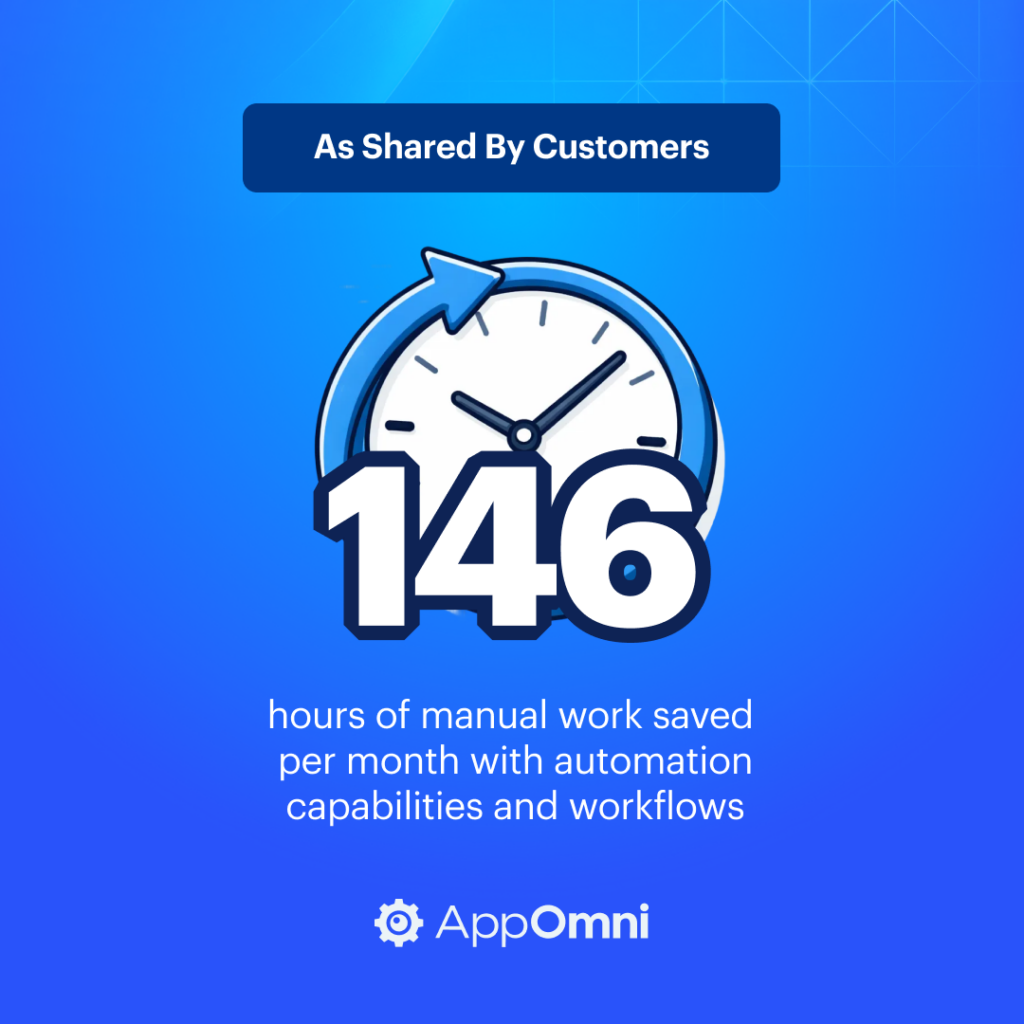
The impact goes beyond cost savings. Teams use that recovered time to focus on higher-value work. Instead of proving that nothing went wrong, they investigate real issues and strengthen security posture. This shift from reactive to proactive work represents a fundamental change in how security operates.
“When I first stood up the security operations program, it was three people day in and day out. They were totally consumed with proving that incidents hadn’t affected us. Now, the SOC team can focus more on actual findings than on noise. We have tools to validate the information, so they can leverage automations rather than playing whack-a-mole.”
Cybersecurity leader
Financial tech company
3. Compliance and audit improvements
Audit and compliance requirements have become increasingly complex, particularly as regulators and insurers place greater emphasis on SaaS risk. Organizations are expected to demonstrate not only that controls exist, but that they are consistently enforced across a rapidly evolving environment.
Without dedicated SaaS security capabilities, this is difficult to achieve. Data is often distributed across multiple systems, evidence collection is time-consuming, and gaps in visibility can lead to unexpected audit findings.
SaaS security improvements have a direct impact on these outcomes. With continuous monitoring and centralized insight into configurations, access, and activity, organizations can identify and remediate issues before they are flagged in audits.
Research shows that 83% of organizations reported improved audit findings with a SaaS security solution, with a 24% reduction in issues identified during audits after adopting SaaS security controls. In addition, audit timelines were reduced significantly, with internal audits decreasing from four weeks to two weeks per application on average.
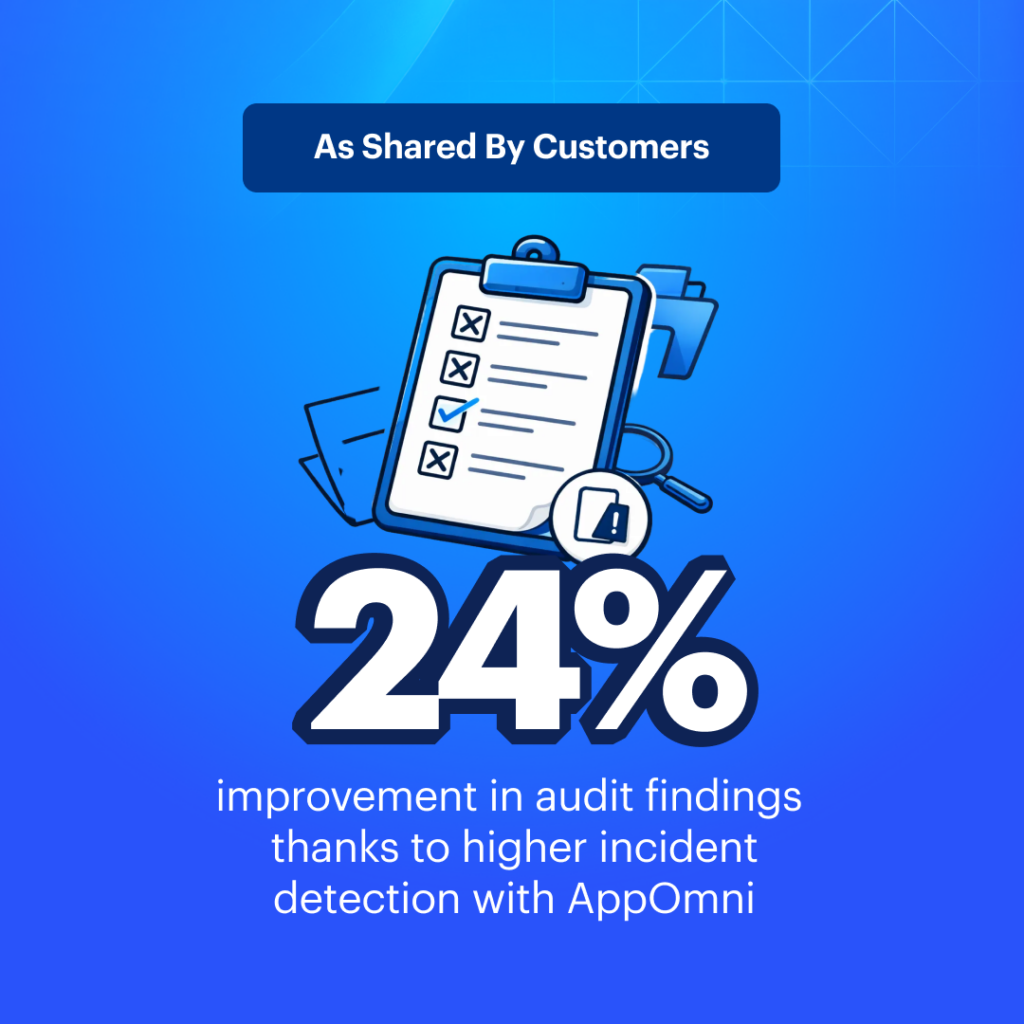
These improvements translate into both direct and indirect value. Organizations spend less time preparing for audits and reduce the likelihood of costly delays or penalties. At the same time, they gain the ability to demonstrate control with confidence. This has become increasingly important in conversations with regulators, customers, and cyber insurance providers, all of whom expect clear evidence that SaaS environments are properly secured.
FAQ: SaaS security ROI
What is a good ROI for SaaS?
The answer to this question is not one-size-fits-all and heavily depends on company size, potential risk, industry, SaaS supply chain, tech stack complexity, and a variety of other factors. A “good” ROI is typically demonstrated through measurable risk reduction, significant time savings, and improved audit outcomes. Rather than aiming for a specific percentage, organizations should look for clear, defensible value (such as avoided breach costs, reclaimed employee hours, and faster compliance processes) that collectively outweigh the cost of the solution.
Is SaaS security worth it?
Yes, SaaS security is worth it because it directly reduces financial risk, operational inefficiencies, and audit friction in environments where critical business data lives. Recent SaaS supply chain attacks, including campaigns like UNC6395 and UNC6040, have shown how quickly identity gaps, misconfigurations, and third-party integrations can lead to widespread exposure. AppOmni’s threat hunting team has consistently highlighted that these risks are not edge cases. They are common, repeatable patterns that organizations can identify and address earlier with the right visibility and control.
With the average SaaS breach estimated at around $1.4 million, even incremental improvements in visibility and risk detection can translate into significant avoided losses. More importantly, organizations gain the ability to demonstrate ownership of SaaS risk and show measurable progress in reducing critical exposures over time. Teams recover hundreds of hours of manual work, improve audit outcomes, and shift from reactive investigations to proactive risk reduction.
SaaS security, in this context, is not just a protective measure. It is a way to consistently reduce risk, prove impact, and operate with greater confidence at scale.
What is the ROI of SaaS security?
The ROI of SaaS security is the measurable business value created by securing SaaS applications and their integrations, typically across three areas: cost avoidance from reduced breach risk, operational efficiency through time savings, and improved compliance outcomes. Rather than a single percentage, it is best understood as a combination of avoided losses, reclaimed resources, and stronger audit performance that together deliver ongoing financial and operational benefits.
How can I maximize ROI on SaaS security investments?
Maximizing SaaS security ROI requires expanding visibility across all SaaS applications and integrations, automating repetitive workflows, and continuously tracking key metrics such as time saved, incidents detected, and audit improvements. Organizations see the greatest returns when they treat SaaS security as an ongoing discipline. They focus on integrating it into operations, refining processes over time, and using measurable outcomes to guide decisions and demonstrate value to leadership.
How do I calculate security ROI?
Security ROI can be calculated by combining three core components: estimated cost avoidance from reduced breach risk, the financial value of time saved through operational efficiency, and improvements in audit and compliance performance. A simple model starts with estimating potential breach cost and applying a risk reduction factor, then adds the value of hours saved using internal labor costs, and finally incorporates reductions in audit time or findings to create a consistent, annualized view of total impact.
The bottom line
Organizations that see the strongest results treat SaaS security ROI as an ongoing discipline. They continuously expand visibility across applications and integrations, automate repetitive workflows, and track key metrics such as time saved, incidents detected, and audit performance. As SaaS environments evolve with new apps, connections, and risks emerging, ongoing measurement ensures that security investments continue to deliver value over time.
By focusing on cost avoidance, operational efficiency, and compliance improvement, organizations can clearly quantify and communicate impact. This shifts SaaS security from a technical function to a business driver, enabling more data-driven decision-making across teams. Security leaders can use ROI to support renewals with clear evidence of value, finance leaders can prioritize investments more effectively, and executives can communicate risk and readiness at the board level.
https://appomni.com/reports/saas-security-roi-report/The outcome is more than stronger security. Organizations reduce exposure to high-cost incidents, reclaim meaningful time across security operations, and improve audit and compliance outcomes—all while increasing confidence among stakeholders. SaaS security, in this context, becomes an enabler of more efficient, predictable, and resilient operations.
Unlock SaaS Security ROI
This report reveals how top organizations are boosting visibility and proving real ROI in as little as two weeks. It delivers data-backed proof of value from real practitioners securing real environments.
Download: Proven ROI for SaaS Security: Insights From AppOmni Customers